Breakthroughs Begin Within
The Subconscious Academy Blog
By Ryan Nichols
Think about where you’d like to be six months from now.
Maybe there’s something you want to have finished. Something you want to be doing differently. A habit you want to break. A part of your life you’re tired of talking about changing.
Now look in the opposite direction.
What have ...
By Ryan Nichols
Key idea: Mental rehearsal can influence emotion, expectation, and behavior, but imagining an outcome does not program destiny. The useful question is what you repeatedly practice internally and how that rehearsal affects what you feel and do next.
Most people think of rehearsal as s...

By Ryan Nichols
Key idea: Insight does not automatically change an old pattern. Habits, expectations, and identity-related behaviors can continue because they have been repeatedly practiced in familiar contexts, even after you consciously decide to change.
Have you ever tried to change your life, fe...
By Ryan Nichols
Key idea: The “story you live inside” is a useful way to describe learned beliefs, expectations, and identity narratives that influence attention and behavior. It is a psychological model, not a claim that one hidden part of the brain literally stores a single life story.
Most people...
By Ryan Nichols
One of the strange things about personal growth is that we often think we’re fighting our habits, our discipline, our confidence, or our circumstances, when we’re actually fighting old rules.
Not formal rules. Not the kind written down anywhere. I mean the quiet internal rules that s...
By Ryan Nichols
Key idea: Consistency usually becomes easier through repetition in stable contexts, not by waiting for motivation. New behaviors often feel effortful before cue-response associations and automaticity have had time to develop.
Most people don’t abandon the thing they care about in one...

By Ryan Nichols
Key idea: Confidence and courage are not fixed traits. Learned associations, past experiences, expectations, and repeated action can all influence what feels safe or possible, which means those responses can change with new experience.
Today, I gave one of the most meaningful talks I...

By Ryan Nichols
Key idea: “Parts” are a useful therapeutic way of describing conflicting motives, emotional states, and learned protective responses. They should not be understood as literal separate personalities or discrete brain modules.
There’s a strange kind of exhaustion that comes from fighti...

By Ryan Nichols
Can you relate to this scenario?
You make progress. Real progress. You hit a milestone that six months ago felt intimidating. You launch the thing. You land the client. You publish consistently. You reach a number that once lived only in your imagination.
And instead of feeling trans...

By Ryan Nichols
There’s a strange moment that tends to show up after things start working.
Not at the beginning, when you’re unsure or inexperienced.
But later. When momentum is real. When the work is landing. When opportunities are opening instead of closing.
That’s usually when people start questio...
By Ryan Nichols
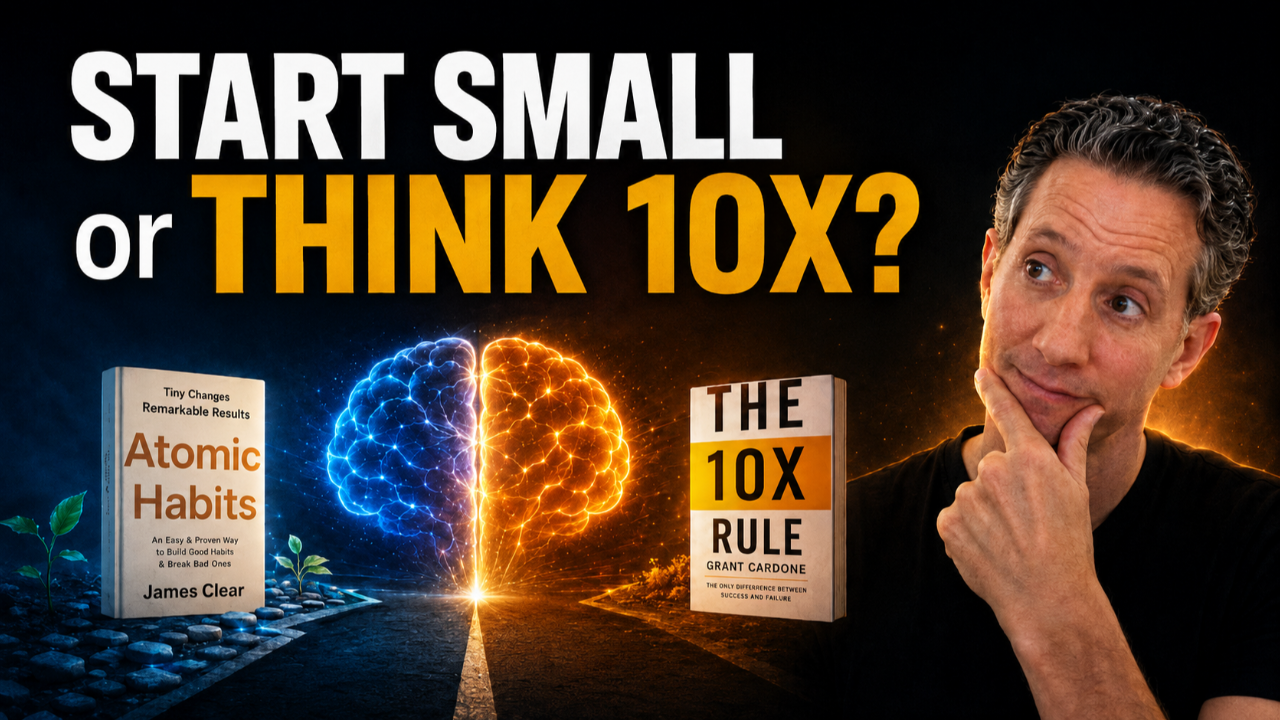
Key idea: “Start small” and “think big” solve different problems. Ambitious goals can create direction and motivation, while small repeatable actions help turn intention into behavior. You do not need to choose one philosophy for every stage of change.
Should you make the goal easi...

By Ryan Nichols
Key idea: Fear of success is not a single brain mechanism. For some people, growth brings more uncertainty, visibility, pressure, or social risk, and those conditions can activate stress and threat responses even when the goal itself is consciously desirable.
We talk endlessly about ...