Your Next 6 Months Will Look Like Your Last 6 Unless This Changes
By Ryan Nichols
Think about where you’d like to be six months from now.
Maybe there’s something you want to have finished. Something you want to be doing differently. A habit you want to break. A part of your life you’re tired of talking about changing.
Now look in the opposite direction.
What have the last six months actually looked like?
Not what you intended to do.
Not what you wrote down at the beginning of the year.
What did you repeatedly do?
That question can be uncomfortable, but it may tell you more about your future than your goals ever could.
Your Patterns Have a Trajectory
We tend to think about the future as something open and undefined.
In one sense, it is.
But our behavior has momentum.
If the same situations continue producing the same reactions, decisions and avoidance, it isn’t difficult to make a reasonable prediction about what happens next.
You keep putting off the difficult conversation.
You keep waiting until you feel more confident before taking action.
You make progress, become uncomfortable, then pull back.
Six months passes surprisingly quickly.
And suddenly you’re standing in almost exactly the same place, wondering why things haven’t changed.
The problem isn’t necessarily that you didn’t want the change badly enough.
It may be that wanting a different result never interrupted the pattern creating the current one.
The Pattern May Be Giving You Something
This is where things get more interesting.
A pattern that keeps repeating usually has some reason for surviving.
It may create problems for you over the long term while providing something very useful in the moment.
Procrastination can give you temporary relief from pressure.
Avoiding visibility can protect you from feeling exposed.
Staying quiet can reduce the immediate risk of conflict.
So while one part of you is thinking about where you want to be six months from now, another part may be responding to a much shorter time horizon.
What will make me feel safer right now?
What will reduce this discomfort?
What feels familiar?
That immediate payoff can be powerful.
The pattern may be costing you in the future while rewarding you in the present.
This is one reason insight alone doesn’t always change behavior.
You can understand perfectly well that something isn’t serving you and still find yourself doing it again
Stop Looking Only at the Behavior
If there’s a pattern you genuinely want to change, it helps to look at more than the behavior itself.
Ask what happens immediately before it.
What are you feeling?
What are you anticipating?
What does the old response give you immediately afterward?
You might notice a sequence such as:
You feel uncertain.
You delay.
You feel relief.
The relief matters.
Your system has just learned, once again, that delay reduces discomfort.
So the next time uncertainty appears, the old response becomes even more familiar.
This is why simply telling yourself to “stop procrastinating” or “be more confident” often doesn’t get very far.
The visible behavior is only part of the pattern.
What Does Another Six Months Cost?
There’s another question worth asking, and it requires some honesty.
Do you actually want to change this?
There are plenty of things we think we should change.
We’d like to exercise more. Be more organized. Stop worrying. Finally launch the project.
But change usually asks something from us.
There may be discomfort, uncertainty, effort, vulnerability or repetition involved.
So instead of vaguely telling yourself that you’ll do better, make the consequences real.
What has this pattern already cost you?
What happens if you repeat it for another six months?
Another year?
Then turn the question around.
What could become possible if you started responding differently?
You don’t need a dramatic life overhaul.
You need enough reason to choose something different when the familiar response shows up.
Change the Pattern, Change the Prediction
Small disruptions matter.
If you normally avoid, take one useful action before you retreat.
If you normally wait until you feel completely ready, move while some uncertainty is still there.
If you normally abandon the effort after a setback, return to it sooner.
The individual action may seem insignificant.
But repeated responses create direction.
A ship that changes course by only a few degrees may look almost unchanged at first. Give it enough distance and it ends up somewhere completely different.
The same can be true of us.
You don’t have to become a different person tomorrow.
You have to start changing what happens at the point where the old pattern normally takes over.
Why Subconscious Work Matters
Conscious awareness is an important beginning.
It allows you to notice the loop rather than simply finding yourself at the end of it again.
But many persistent patterns are connected to deeper emotional learning, beliefs, associations and ideas about what feels safe or familiar.
That’s why you can consciously know exactly what you want and still feel pulled toward something else.
You may be able to override the old response through effort for a while.
But if the deeper pattern remains intact, the same pull can keep returning.
This is where subconscious work becomes particularly valuable.
Instead of focusing only on the behavior you can see, you begin working with what may be helping generate and reinforce that behavior underneath.
That’s also why change can sometimes feel easier once the deeper pattern begins to shift. You’re no longer spending quite as much energy fighting yourself at the surface.
Look Back to See Forward
In my latest video, Your Next 6 Months Will Look Like Your Last 6 Unless This Changes, I walk through a simple way to examine the patterns shaping your trajectory and begin interrupting them.
The point isn’t to become pessimistic about your future.
It’s almost the opposite.
If your repeated patterns help predict where you’re heading, then changing those patterns gives you a way to change the prediction.
Six months from now is going to arrive either way.
The question is whether you’ll still be rehearsing the same responses when it does.
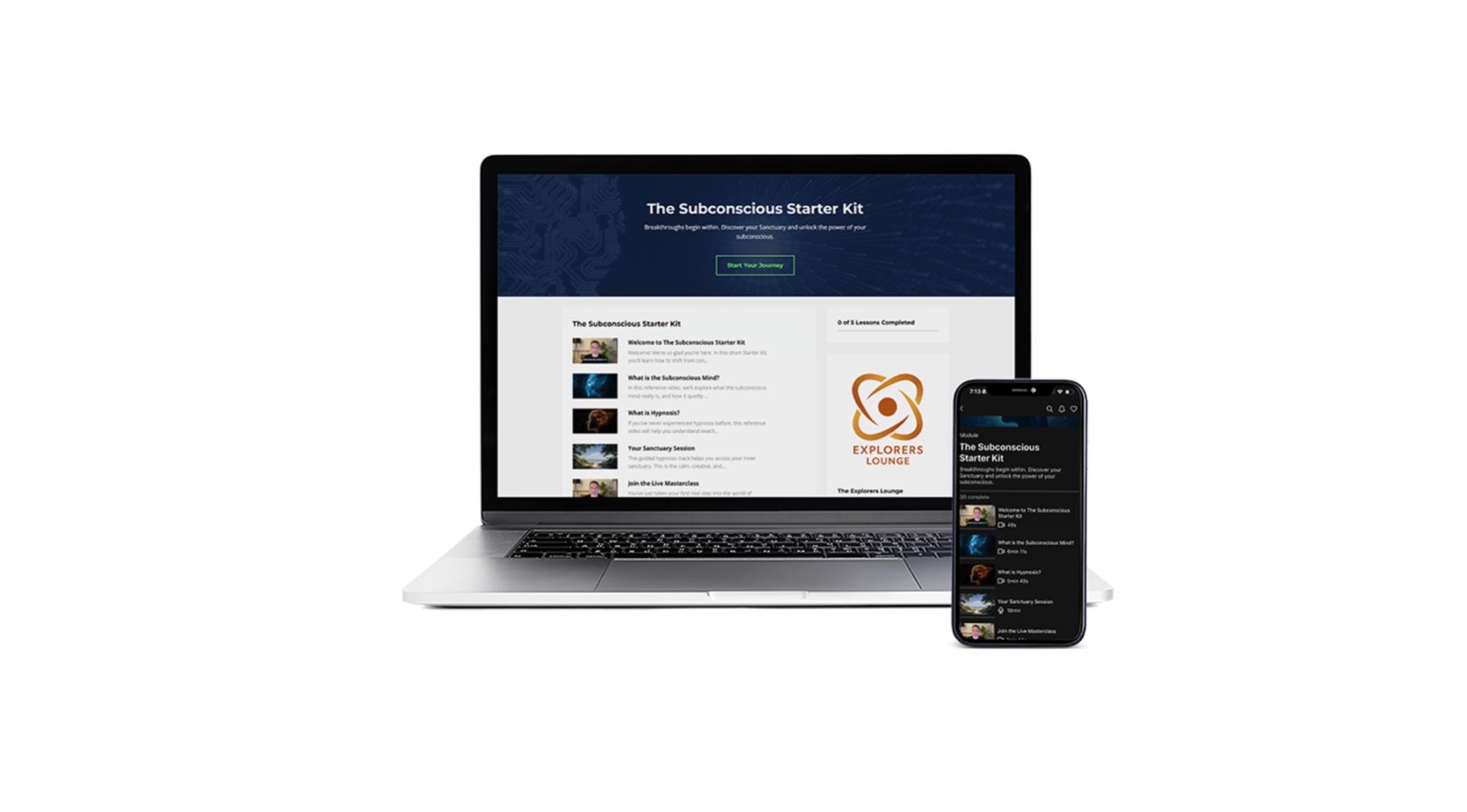
If you want to start exploring the subconscious patterns underneath your own behavior, you can also download the free Subconscious Starter Kit. It includes short guidance to help you better understand these deeper patterns, along with the Sanctuary Session, a guided audio designed to help you slow down, quiet some of the mental noise, and check in with what may be happening underneath your automatic reactions.
Your past may be one of the best predictors of your future. But only if you keep repeating it.
Breakthroughs Begin Within.
If you want to explore this idea further, you may also find The Secret to Sticking With It and The Old You Is Still Running Your Life useful.
Start with the Free Starter Kit to better understand the patterns behind your resistance, build steadier internal alignment, and access our free live training.