Train Your Brain to Feel Better on Cue
By Ryan Nichols
Key idea: Emotional anchors are learned associations between cues and responses. Repeated pairings can strengthen an association, but the effect is not guaranteed or instantaneous, and emotions always have more than one possible cause.
A song comes on that you haven’t heard in years, and suddenly you remember more than the music.
You remember the car you were driving. The person beside you. How life felt at that particular moment.
A few seconds of sound brings back a feeling you haven’t thought about in a long time.
Then there’s the other version.
You’re enjoying dinner on a Sunday evening when your phone plays the chime you’ve assigned to your work email. Before you’ve even looked, your shoulders tighten and your attention shifts to the client who still hasn’t approved the project.
The email might just be a newsletter.
But the sound has already triggered a feeling in you.
Most of us recognize these experiences. What we may not consider is whether we can deliberately build a connection that helps us.
How Ordinary Things Acquire Emotional Meaning
You’ve probably heard of Pavlov’s dogs.
After a sound was repeatedly paired with food, the dogs began salivating in response to the sound itself. Something previously meaningless had become a signal for what came next.
Our emotional lives are more complicated, but learned associations are part of them too.
A familiar scent reminds you of someone you love. A particular tone of voice puts you on edge. Walking into a room brings back something of how you felt the last time you were there.
Through experience, a cue can become linked to a feeling.
That’s what we mean by an emotional anchor: a learned connection between a trigger and a response.
Many of these connections develop without us deliberately choosing them. Sometimes we notice the feeling long before we recognize what brought it on.
The Connections You Don’t Notice
That work email chime may have accompanied months of deadlines, demands, and difficult conversations.
Eventually, the sound alone can make you tense.
You’re still at dinner, but you’re preparing for another problem. The person sitting beside you gets a distracted answer or an impatient response, even though they’ve done nothing wrong.
This is one cost of being unaware of your anchors. An association from one part of your life can influence how you experience another.
When you notice a shift in your mood, there’s a useful question to ask:
What happened just before I started feeling this way?
You won’t always find an obvious answer. Emotions have many causes.
But sometimes you’ll recognize a connection you’ve been responding to for years. That recognition gives you more information about what’s happening, and a little more room to choose your response.
Practice Before the Pressure Arrives
Watch a golfer preparing for a difficult shot or a basketball player standing at the free-throw line.
You’ll often see a familiar sequence of movements and breaths.
These routines serve several purposes, including focusing attention and preparing the movement. They can also help the player settle down and approach the moment with confidence.
There’s something useful to borrow from that.
Practice accessing a helpful state before the moment when you need it.
If you want to feel calm and confident in a meeting, you can begin exploring that experience somewhere less demanding.
Give yourself an opportunity to learn the connection without also having to manage the pressure.
Give the Cue Something to Connect To
Start by remembering a conversation where you felt comfortable and capable.
Perhaps you were explaining something you knew well to someone who was genuinely interested. You had time to speak, and you trusted what you had to offer.
Recall your posture, your voice, and the feeling of being at ease.
As some of that calm confidence becomes noticeable, gently press your left thumb and middle finger together and take two slow, comfortable breaths. Then release your fingers.
The feeling matters. You’re giving a specific gesture an experience to become associated with.
Practice that pairing on other occasions, including moments when you naturally notice yourself feeling calm and confident. Repeated pairings can help strengthen the connection.
Later, try the gesture and breaths before speaking in an ordinary meeting.
Notice what happens.
You may rush a little less or feel more willing to contribute. The effect may be subtle, and it can vary. If nothing changes, return to practicing when the feeling is easier to access.
You still need to prepare for the meeting. This is one resource you can bring with you.
More Say in How You Feel
In my latest video, Train Your Brain to Feel Better on Cue, I explore how these associations develop, how unnoticed cues can influence your mood, and how to begin practicing an anchor of your own.
The goal is to give yourself more ways to access feelings that support you, whether that’s calm confidence before a conversation, relaxation before bed, or energy before a performance.
Watch the video below and choose one situation where you’d like to try the practice.
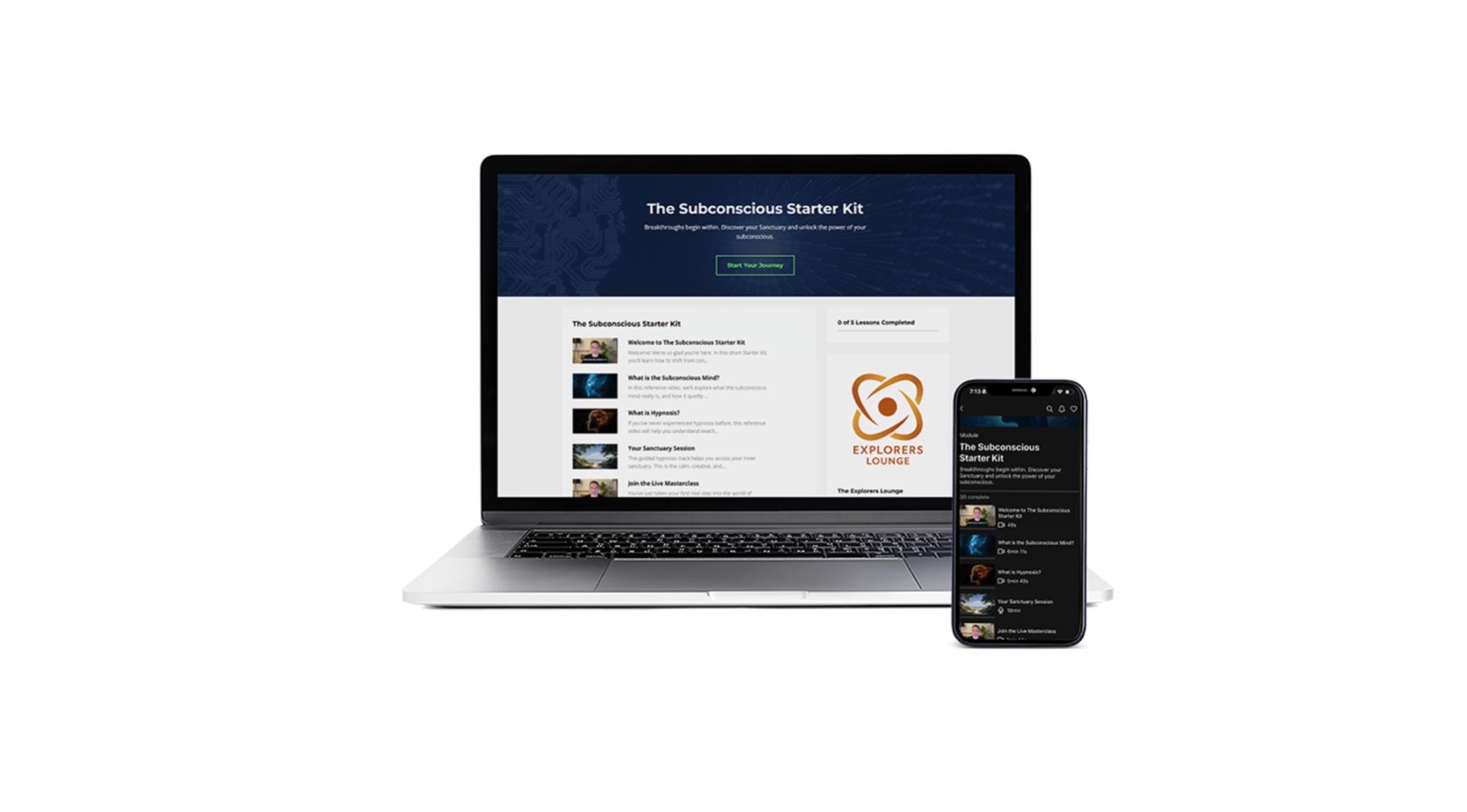
If you’d like a guided place to begin, the free Subconscious Starter Kit includes introductory videos and the Sanctuary Session, a guided hypnosis audio designed to help you relax and create your own peaceful inner retreat.
As you return to that experience, its familiar voice and imagery may become cues that help you settle into relaxation.
You already know what it’s like for a song to change how you feel.
Now you have a way to start exploring that shift on purpose.
Breakthroughs Begin Within.
Sources & Further Reading
Start with the Free Starter Kit to better understand the patterns behind your resistance, build steadier internal alignment, and access our free live training.