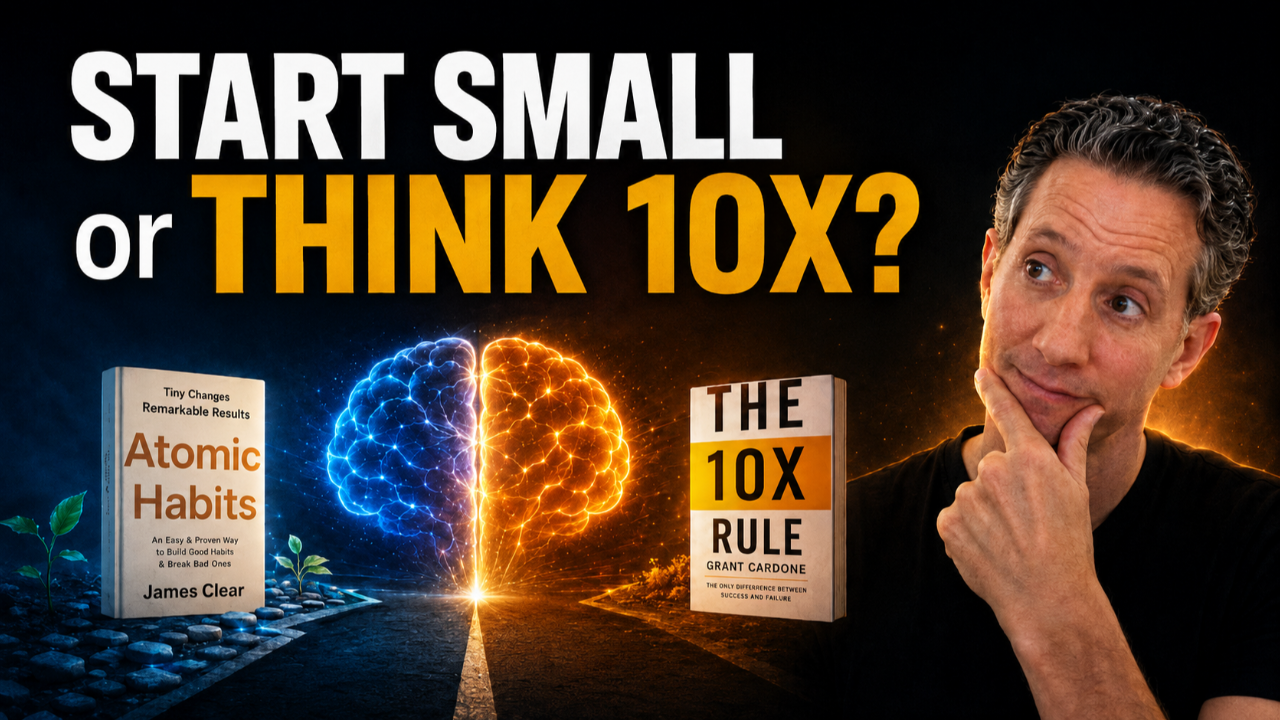
Should You Start Small or Think 10X? The Truth About How Real Change Happens
By Ryan Nichols
Key idea: “Start small” and “think big” solve different problems. Ambitious goals can create direction and motivation, while small repeatable actions help turn intention into behavior. You do not need to choose one philosophy for every stage of change.
Should you make the goal easier or make it bigger?
Personal development tends to give two opposite answers.
One camp says small actions compound. Make the habit easy. Lower the friction. Build gradually.
The other says the goal should be large enough to demand a different level of thinking and behavior.
Both ideas can be useful. They are just addressing different parts of the change process.
Big Goals Can Create Direction
Goal-setting research generally finds that setting goals can improve behavior, and one large meta-analysis found that more difficult goals were associated with larger effects under some conditions.
That does not mean “bigger is always better.” A goal that is impossible, vague, or disconnected from the person’s resources can create frustration rather than useful challenge.
But an ambitious goal can force an important question:
What would have to change about how I operate if I were serious about this?
That can challenge assumptions and prevent incremental thinking from becoming a way of staying comfortably inside the current system.
Small Actions Solve a Different Problem
A bold goal does not tell you what to do at 9:00 tomorrow morning.
That is where smaller actions matter.
Habit research shows that repetition in stable contexts helps behaviors become more automatic. The behavior does not need to feel profound every time. It needs to occur often enough for the cue-response relationship to strengthen.
So a big goal might be “publish a book.”
The small behavior might be “write for thirty minutes after breakfast.”
The first creates direction. The second creates repetition.
The Problem With Turning Either Idea Into a Religion
If you only start small, you can become excellent at making tiny improvements to a life or business that actually needs a larger strategic change.
If you only think big, you can become excellent at generating emotionally exciting goals without building the behaviors that make them real.
The useful combination is:
Think far enough ahead to change the game.
Act small enough that you can repeat the behavior.
What About the “Comfort Zone”?
You do not need to believe that the brain automatically treats every unfamiliar goal as danger.
Uncertainty can be uncomfortable, and people differ in how strongly they react to it. But unfamiliarity is not inherently pathological.
A better approach is to choose a stretch that creates useful challenge without making the next action so vague or overwhelming that avoidance becomes the easiest response.
You can increase the stretch as your skill, evidence, and capacity grow.
A Practical Way to Combine Both Approaches
1. Pick the direction. What would you genuinely like to make true over the next year or several years?
2. Identify the behavior. What recurring action would create evidence that you are moving toward it?
3. Make the behavior specific. Decide when, where, and how you will do it.
4. Review the system, not just the result. If you are not following through, ask whether the action is unclear, poorly cued, emotionally loaded, or simply unrealistic.
5. Adjust without shrinking the vision automatically. A difficult week may mean the process needs changing, not the goal.
The Takeaway
Real change does not require choosing between tiny habits and bold ambitions.
You can hold a large vision and build it through repeatable behavior.
The vision tells you where you are going.
The repetition teaches you how to live there.
If you want a guided way to explore the automatic patterns that can affect follow-through, the free Subconscious Starter Kit includes foundational lessons and the Sanctuary Session guided hypnosis experience.
Sources & Further Reading
- Epton et al. (2017), Unique effects of setting goals on behavior change
- Wood & Rünger (2016), Psychology of Habit
- Context stability in habit building increases automaticity and goal attainment
- Goal-setting interventions for behavior change: systematic review and meta-analysis
If you want to explore this idea further, you may also find Why Pushing Through Resistance Often Backfires and The Secret to Sticking With It useful.
Start with the Free Starter Kit to better understand the patterns behind your resistance, build steadier internal alignment, and access our free live training.