The Courage We Forget We Have
By Ryan Nichols
Key idea: Confidence and courage are not fixed traits. Learned associations, past experiences, expectations, and repeated action can all influence what feels safe or possible, which means those responses can change with new experience.
Today, I gave one of the most meaningful talks I’ve ever given.
Not on a stage.
Not in a boardroom.
Not to entrepreneurs, executives, or coaching clients.
To my daughter’s Grade 2 class.
The topic was courage.
And as I stood there in front of a room full of seven-year-olds, I was reminded of something I wish every adult could remember:
We are all forming an identity long before we realize we have one.
At that age, children are still wide open. They’re curious, expressive, imaginative, and beautifully unfiltered. But they are also already beginning to collect evidence about who they are.
Some are starting to believe they’re smart.
Some are starting to believe they’re not.
Some are deciding they’re brave.
Some are deciding they’re shy.
Some are beginning to feel capable.
Some are quietly wondering if they’re behind.
And most of the time, those early conclusions don’t arrive as dramatic announcements. They come through small moments. A comment from a teacher. A comparison with a classmate. A mistake that felt embarrassing. A moment of praise. A moment of rejection. A moment when they tried something difficult and either felt supported or exposed.
Bit by bit, children begin to answer the question:
“Who am I?”
That question matters more than most of us realize.
At the end of the talk, I told the class I had spent a long time looking for a picture of someone I believed was truly courageous.
Someone brave.
Someone capable of amazing things.
Someone they might even recognize as a kind of superhero.
I told them I had brought the picture with me.
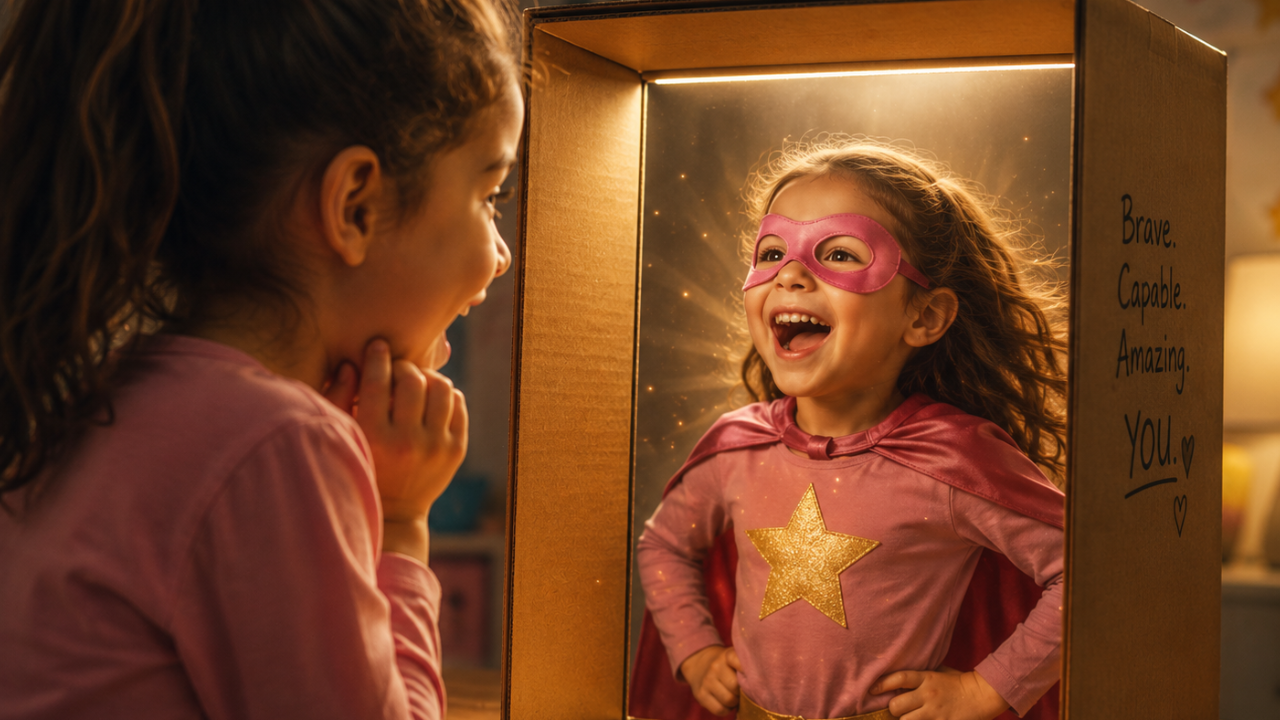
Then I placed a small box at the front of the room.
One by one, each child came up to look inside.
But there wasn’t a photograph in the box.
There was a mirror.
Watching their faces was unforgettable.
At first, surprise.
Then confusion.
Then delight.
And then, for some of them, something softer and deeper.
Recognition.
I told them, “The person you see in that box is brave, capable, important, and stronger than they realize. They’re a superhero.”
And you could feel it land.
Not as a slogan. Not as a cute classroom activity. But as a possibility.
For a few seconds, they weren’t being told about courage as an abstract idea.
They were seeing themselves as the answer.
And that matters.
Because the stories we learn about ourselves early in life can stay with us for decades.
I see this with adults all the time.
People come to me believing they lack discipline, confidence, consistency, motivation, or courage. But often, when we go deeper, the real issue is not that they’re broken or incapable.
It’s that somewhere along the way, they learned a story about themselves.
“I’m not confident.”
“I never follow through.”
“I’m bad with money.”
“I’m too anxious.”
“I’m not leadership material.”
“I always self-sabotage.”
“I’m just not the kind of person who can do that.”
And after years of repetition, those statements stop sounding like stories.
They start sounding like truth.
That is the power of learned association: experience can quietly shape what feels natural, risky, or possible.
A belief doesn’t have to be accurate to shape your life. It only has to feel familiar. Once the mind accepts something as “me,” it begins filtering experience through that identity. You notice the evidence that confirms it. You dismiss the evidence that contradicts it. You behave in ways that keep it alive.
Not because you’re weak.
Familiar responses are often easier to repeat because they have been practiced before.
This is why courage is not just about forcing yourself to do hard things.
Sometimes courage is much quieter than that.
Sometimes courage is looking at an old identity and asking, “Is this actually true?”
Sometimes courage is noticing the story you’ve carried for years and realizing it may have been learned in a moment when you were too young, too scared, too overwhelmed, or too unsupported to question it.
Sometimes courage is not becoming someone new.
It’s remembering someone original.
The part of you that was curious before you became self-conscious.
The part of you that tried before you learned to fear looking foolish.
The part of you that imagined freely before the world taught you to be realistic.
The part of you that knew how to dream before disappointment made dreaming feel dangerous.
That part is not gone.
It may be buried under years of conditioning, pressure, comparison, responsibility, and survival.
But it is not gone.
And this is one of the reasons I care so deeply about subconscious work.
Because so many people are living far below their true capacity, not because they lack intelligence, talent, or potential, but because they learned to see themselves too small.
They learned to identify with fear.
They learned to confuse protection with truth.
They learned to call old programming “personality.”
But what was learned can be unlearned.
What was learned can also be updated through new learning and repeated experience.
What was forgotten can be reclaimed.
Every seven-year-old deserves the chance to look in the mirror and see someone brave, capable, important, and strong.
But so does every forty-seven-year-old.
Every seventy-seven-year-old.
Every ninety-seven-year-old.
All of us.
Because there is a part of us that still needs that reminder.
There is a part of us that still wants permission to believe in what’s possible.
There is a part of us that still remembers.
Maybe that’s what courage really is.
Not pretending we’re fearless.
Not performing confidence.
Not becoming someone else.
But reconnecting with who we were before the world convinced us otherwise.
Breakthroughs Begin Within.
Sources & Further Reading
- The Origins and Organization of Pavlovian Conditioning
- The role of Pavlovian conditioning in learned emotional responses
If you want to explore this idea further, you may also find Afraid to Start? Here’s How to Rewire Self-Doubt and Take Action and Why You’re So Hard on Yourself useful.
Start with the Free Starter Kit to better understand the patterns behind your resistance, build steadier internal alignment, and access our free live training.