How Hypnosis Rewires the Brain: The Neuroscience of Belief and Transformation
By Ryan Nichols
Key idea: Hypnosis is not a single magical “rewiring state.” It is a focused state in which attention and responsiveness to suggestion can change, and research shows measurable changes in brain activity and network connectivity. The exact pattern varies across people, suggestions, and study designs.
People often talk about beliefs as if they are files stored somewhere in the brain. The reality is more interesting.
A belief is not one wire or one brain region. It emerges from patterns involving memory, prediction, attention, emotion, and learned response. When those patterns are repeated, they can become increasingly automatic. And because the brain remains plastic throughout life, learned patterns can also change.
That is where hypnosis becomes relevant.
What Hypnosis Actually Is
Modern research does not define hypnosis as sleep or loss of control. A widely used scientific definition describes it as a state involving focused attention, reduced peripheral awareness, and an increased capacity to respond to suggestion.
In practical terms, your attention becomes more absorbed in a particular experience. Suggestions, imagery, sensations, and meanings can become more vivid and influential while competing input becomes less prominent.
That does not mean the conscious mind “switches off.” You are still capable of awareness, judgment, and choice.
What Brain Imaging Shows
Neuroimaging studies do find measurable differences during hypnosis, but there is no single universal “hypnosis brain state.” Reviews of fMRI, PET, and EEG research show changes in networks involved in attention, salience, self-referential thinking, and cognitive control. The findings are meaningful, but they are also heterogeneous.
One influential fMRI study found reduced activity in the dorsal anterior cingulate cortex during hypnosis, increased connectivity between executive-control regions and the insula, and reduced connectivity between executive-control regions and parts of the default mode network.
Those findings fit an important idea: hypnosis can change how attention is allocated and how internal experience is processed. But the science is more nuanced than saying one part of the brain simply “turns off” while another turns on.
What About Alpha, Theta, and Gamma Brainwaves?
Brainwave frequencies are real patterns of electrical activity measured with EEG. They are associated with different kinds of brain activity, but they should not be treated like five gears that each produce one mental state.
Research on hypnosis has found associations with theta activity and, in some studies, changes in gamma activity. Other studies show different patterns, and hypnotizability matters. Meditation research also finds changes in alpha, theta, beta, and gamma activity depending on the type of practice and the person.
So it is reasonable to say that focused or hypnotic states can be accompanied by shifts in brain rhythms. It is not accurate to say that hypnosis always moves the brain from “beta” into one specific frequency.
Can Hypnosis Help Change Beliefs and Behavior?
This is where the practical value becomes more interesting.
Hypnosis combines focused attention with suggestion, imagery, expectation, and emotional experience. Those are all processes involved in learning. Suggestions can influence perception, pain, attention, and subjective experience, and repeated learning can contribute to longer-term changes in behavior.
Clinical evidence is strongest in some areas rather than all of them. A 2024 overview of meta-analyses found the most robust evidence for hypnosis in pain and medical-procedure settings. Research also supports hypnosis as an adjunct to cognitive behavioral therapy in some contexts, although effects vary by condition and study quality.
That distinction matters. Hypnosis is not a universal treatment for every psychological problem, and it should not be presented that way. But it is a legitimate psychological tool with a growing evidence base.
What “Rewiring” Really Means
When I use the word rewiring, I am using it as practical shorthand for learning and neuroplasticity.
Your brain changes through experience. Repeated thoughts, actions, emotional responses, and expectations can strengthen familiar patterns. New experiences can create competing patterns and, with repetition, make different responses easier to access.
Hypnosis can be useful because it gives us a structured way to work with attention, imagery, meaning, and suggestion while someone is highly engaged in the experience.
That is different from claiming that a hypnotic suggestion instantly rewrites a neural pathway. Sometimes change feels sudden. The underlying learning process is usually more complex.
The Subconscious Window
Inside Subconscious Academy, we sometimes use the phrase Subconscious Window to describe a period of focused, emotionally engaged attention in which someone feels especially receptive to new learning.
That is our teaching language, not a formal neuroscientific term.
The useful idea underneath it is straightforward: learning is influenced by attention, emotion, expectation, repetition, and experience. Hypnosis deliberately brings several of those ingredients together.
The Takeaway
Hypnosis does not work because the brain becomes passive. If anything, the research points toward a more active process involving focused attention and altered coordination among brain networks.
And “rewiring” is not about erasing who you are. It is about creating new learning strongly enough that an old automatic response is no longer the only response available.
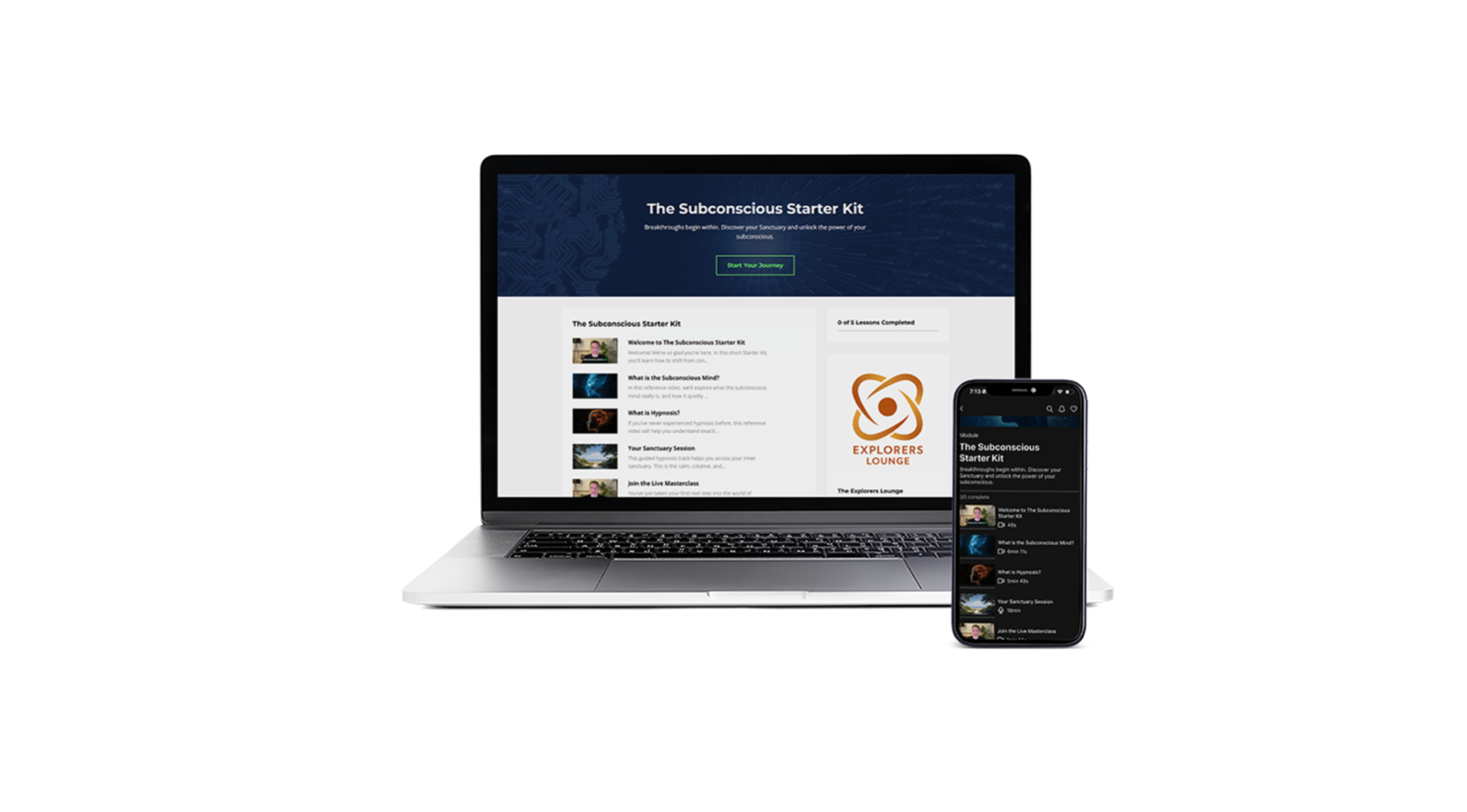
If you want a practical introduction to this work, the free Subconscious Starter Kit includes foundational lessons and a guided hypnosis experience you can try for yourself.
Sources & Further Reading
- Landry et al. (2017), Brain correlates of hypnosis: systematic review and meta-analysis
- Faymonville et al. (2022), Functional changes in brain activity using hypnosis: systematic review
- De Pascalis (2024), Brain functional correlates of hypnosis and hypnotizability
- Rosendahl et al. (2024), Meta-analytic evidence on hypnosis for mental and somatic health issues
- Ramondo et al. (2021), Clinical hypnosis as an adjunct to cognitive behavior therapy
Research & Further Reading
For readers who want to go deeper into the research behind these ideas:
- Functional Changes in Brain Activity Using Hypnosis: A Systematic Review
- Brain Functional Correlates of Resting Hypnosis and Hypnotizability: A Review
If you want to explore this idea further, you may also find The Hidden Switch in Your Brain and The Real Reason You Keep Fighting Yourself useful.
Start with the Free Starter Kit to better understand the patterns behind your resistance, build steadier internal alignment, and access our free live training.