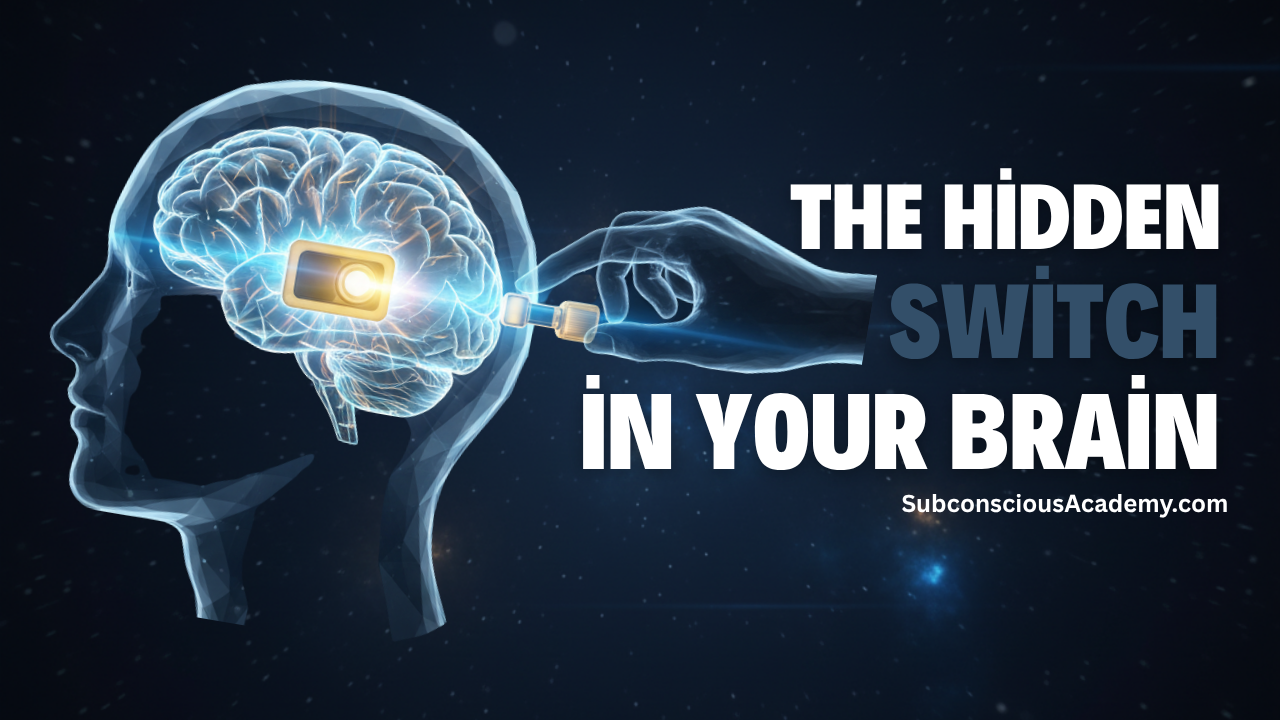
The Hidden Switch in Your Brain
By Ryan Nichols
Key idea: The “hidden switch” is a metaphor, not a literal neural switch. What can feel like an instant breakthrough is often a rapid shift in attention, meaning, expectation, or learned response that makes a new interpretation suddenly feel more believable than the old one.
What if the difference between staying stuck and moving forward sometimes feels as small as a single internal shift?
Most people assume change has to happen gradually because habits and beliefs are deeply learned. Often it does.
But sometimes a person suddenly sees something differently. A fear loses its grip. A decision becomes obvious. A belief that felt permanent stops feeling true.
That is what I mean by the hidden switch in your brain.
Why Change Can Feel Sudden
Your brain is constantly updating predictions about what is safe, important, and likely to happen next.
Most updates are small. But occasionally enough new information accumulates that the interpretation changes quickly.
Think about realizing that someone you feared was actually trying to help you, or recognizing that a story you have repeated for years no longer fits the facts.
The insight may arrive in one moment, even though the learning that made it possible was building for much longer.
Where Hypnosis Fits
Hypnosis can create conditions that make this kind of focused updating easier to explore.
Modern definitions of hypnosis emphasize focused attention, reduced peripheral awareness, and increased responsiveness to suggestion. Neuroimaging studies show changes in systems involved in attention, salience, cognitive control, and self-referential processing.
There is not one universal “hypnosis brain state,” and hypnosis does not simply turn off the analytical mind. The more accurate picture is that attention becomes highly organized around a particular experience while competing information becomes less dominant.
That makes imagery, suggestion, meaning, and emotional learning especially important.
The Role of Neuroplasticity
Neuroplasticity refers to the brain’s ability to change through experience and learning.
That does not mean one hypnotic insight physically rewires an entire network in an instant. It means new learning can begin to compete with an old pattern, and repetition can strengthen the newer response over time.
Sometimes the subjective experience of that update is dramatic. The person thinks, “I suddenly see this differently.”
The feeling of an instant switch is real, even when the underlying biology is more gradual.
Why Imagery Can Feel So Powerful
Mental imagery is not the same as perception, but research shows that imagery recruits overlapping perceptual systems and can produce real emotional and physiological responses.
That helps explain why vividly imagining a feared future can increase anxiety, and why rehearsing a calm, capable response can influence how a future situation feels.
Hypnosis often uses imagery precisely because a vivid internal experience can carry more emotional weight than an abstract statement.
You Have Probably Felt This Before
Think about a time when something suddenly made sense.
You may have spent weeks thinking about the issue. Then one conversation, question, image, or realization reorganized the whole thing.
That is the kind of moment I am pointing to with the phrase “hidden switch.”
Not magic. Not a literal switch. A meaningful update.
The Takeaway
Change can be gradual or surprisingly fast.
Hypnosis, imagery, reflection, and emotionally significant experiences can all create opportunities for new learning. What matters after the insight is whether the new pattern is reinforced through repetition and real-world experience.
If you want to experience this kind of focused subconscious work for yourself, the free Subconscious Starter Kit includes foundational lessons and a guided hypnosis experience.
Sources & Further Reading
- Brain correlates of hypnosis: systematic review and meta-analysis
- Functional Changes in Brain Activity Using Hypnosis: systematic review
- Mental Imagery: Functional Mechanisms and Clinical Applications
Research & Further Reading
For readers who want to go deeper into the research behind these ideas:
- Functional Changes in Brain Activity Using Hypnosis: A Systematic Review
- Brain Functional Correlates of Resting Hypnosis and Hypnotizability: A Review
If you want to explore this idea further, you may also find How Hypnosis Rewires the Brain: The Neuroscience of Belief and Transformation and Train Your Brain to Feel Better on Cue useful.
Start with the Free Starter Kit to better understand the patterns behind your resistance, build steadier internal alignment, and access our free live training.