Breakthroughs Begin Within
The Subconscious Academy Blog

By Ryan Nichols
A folder full of saved tutorials can be a reassuring thing. You’ve found useful people to learn from. You’ve collected examples. When you have a little more time, you’ll sit down and try them.
But sometimes that collection grows while your experience stays much the same. Each new tut...
By Ryan Nichols
A piece of knowledge can become so familiar that you stop noticing what it makes possible.
You use it to recognize a problem, ask a useful question, or avoid a mistake. Yet when you consider sharing it, you hesitate. Surely everyone knows that already.
For coaches, consultants, cr...

By Ryan Nichols
Key idea: Procrastination is often less about laziness than short-term emotion regulation. “Productive procrastination” happens when useful, lower-stakes tasks provide immediate relief from the discomfort attached to a more important task.
There is a particular kind of frustration th...

By Ryan Nichols
Can you relate to this scenario?
You make progress. Real progress. You hit a milestone that six months ago felt intimidating. You launch the thing. You land the client. You publish consistently. You reach a number that once lived only in your imagination.
And instead of feeling trans...

By Ryan Nichols
Key idea: Better tools remove external friction, but they cannot remove every source of hesitation. When execution gets easier, uncertainty, evaluation, procrastination, and emotional resistance can become more visible because there are fewer practical obstacles to blame.
Lately, I’v...
By Ryan Nichols
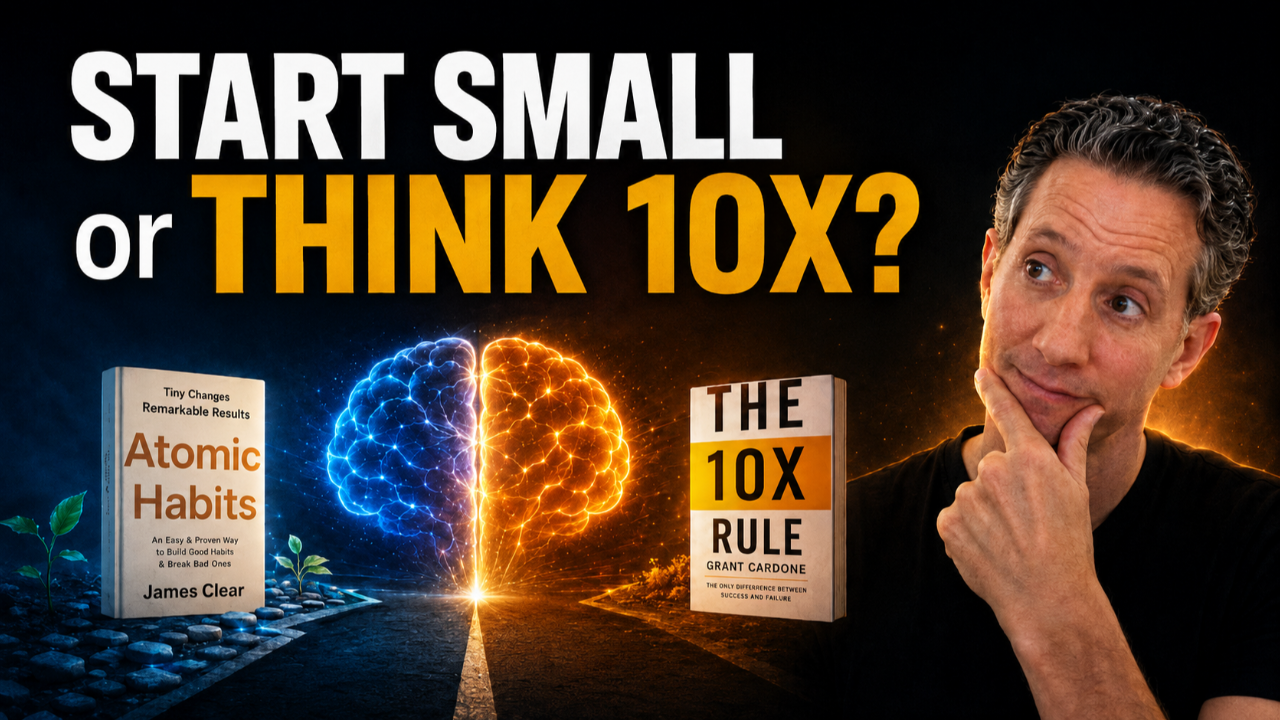
Key idea: “Start small” and “think big” solve different problems. Ambitious goals can create direction and motivation, while small repeatable actions help turn intention into behavior. You do not need to choose one philosophy for every stage of change.
Should you make the goal easi...

By Ryan Nichols
Key idea: Better strategy cannot solve every execution problem because follow-through is influenced by more than conscious plans. Habits, emotion, uncertainty, attention, environmental cues, and learned expectations can all affect whether a good strategy is actually used.
If you’ve b...

By Ryan Nichols
Technology is evolving faster than ever.
AI systems are reshaping industries, robots are entering workplaces, and the pace of change is accelerating with each passing month.
But the real crisis isn’t technological. It’s personal.
We’re entering a moment where technology is evolving f...

By Ryan Nichols
Key idea: Entrepreneurs often know what matters and still avoid doing it. That gap is not automatically laziness or a lack of strategy. Procrastination, uncertainty, fear of evaluation, habits, and short-term emotional relief can all pull attention toward safer work instead of the w...

By Ryan Nichols
You had a great idea.
It felt clear, exciting, maybe even energizing. The kind of idea that could actually move something forward.
But then, almost out of nowhere, you started questioning it.
Is this really any good?
Will anyone care?
Should I tone it down, clean it up, make it more like ...

By Ryan Nichols
Key idea: Feeling stuck often comes from a small set of repeatable patterns: using learning to delay action, treating imperfect progress as failure, and waiting for confidence before beginning. These patterns are understandable, but they are trainable.
You can know what to do and s...