The Hidden Reason You’re Always Busy but Still Stuck

There is a particular kind of frustration that comes from ending a day exhausted and still knowing, somehow, that the important thing did not move.
Not nothing. Plenty happened. Emails were answered. Small fires were handled. A few practical tasks got crossed off. Maybe a drawer got organized. A document got cleaned up. Something in the house got straightened. Something in the business got tweaked. The day was not empty. In fact, it may have been packed.
And yet the deeper feeling remains: I was busy, but I didn’t really move.
I think a great deal of modern avoidance lives inside that sentence.
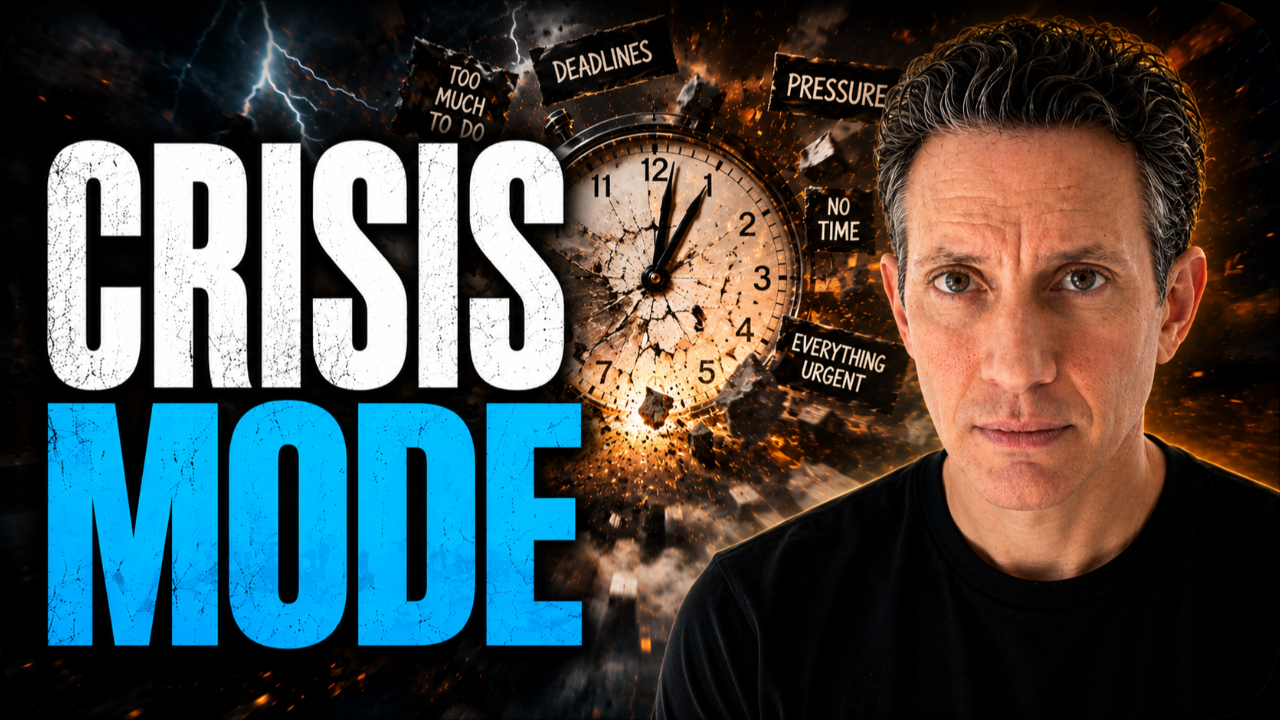
Most people imagine procrastination as something obvious. They picture a person doing nothing, numbing out, avoiding responsibility altogether. But some of the most costly forms of avoidance do not look lazy at all. They look conscientious. They look organized. They look like effort. Sometimes they even look admirable. A person appears to be handling life, staying on top of things, remaining productive. From the outside, and often from the inside too, there is enough motion to quiet the accusation that they are stuck.
But motion and progress are not the same thing.
And once that distinction is blurred, a person can spend a shocking amount of time circling the work that matters most while still feeling entitled to say they have been trying.
This is why “busy” can become such a seductive identity. It offers a strange psychological shelter. If you are busy, you do not have to fully face the question of whether you are being brave. If you are active, you can delay the harder question of whether you are moving what actually matters. Busyness creates the appearance of engagement while often protecting a person from the very friction that would create meaningful change.
That friction is worth examining.
Because the task people keep avoiding is rarely difficult only because of the task itself. More often, it is difficult because of what it represents. A sales call is not just a sales call. It is exposure. A pitch is not just a pitch. It is the possibility of rejection. Publishing something meaningful is not just publishing. It is being seen. Setting a boundary is not just communication. It is the risk of changing a dynamic that has become familiar. Launching the offer, making the ask, sending the application, recording the video, having the real conversation — these things carry emotional weight far beyond their practical description.
And that is usually where avoidance begins.
Not at the level of laziness, but at the level of protection.
The mind, and more deeply the subconscious, is not only concerned with achievement. It is also concerned with safety. It prefers what is familiar. It prefers what keeps identity intact. It prefers what does not expose the person too quickly to uncertainty, judgment, failure, success, or change. So when a task carries too much emotional risk, the system often does not say, “Don’t do anything.” It says something far more convincing: “Do this other thing first.”
That is the beginning of what I think of as productive procrastination.
Answer the easy emails before making the difficult call.
Tidy the desk before starting the page.
Rework the branding before publishing the offer.
Research a few more tools before making the decision.
Update notes, sort folders, clean the kitchen, organize the bookshelf, finally edit the photos, handle some low-stakes task that has suddenly acquired a remarkable sense of urgency.
None of these things are entirely fake. That is precisely why the pattern is so powerful. The replacement tasks are often real tasks. They do need doing. They just do not carry the same psychological charge as the thing being avoided. They offer the relief of action without the cost of vulnerability.
And so a compromise is formed.
The person gets to feel responsible.
They get to feel active.
They get to avoid the shame of doing nothing.
And they get to postpone the emotional risk of what matters most.
It is a very efficient arrangement, at least in the short term. But over time it becomes expensive.
The obvious cost is delayed progress. Projects stall. Decisions linger. Important work remains untouched. But the deeper cost is harder to measure and more corrosive. It shows up in the relationship a person develops with themselves.
Every time someone repeatedly does everything except the thing that matters, they teach themselves something. They teach themselves that when discomfort appears, they drift. They teach themselves that safer tasks win. They teach themselves that movement is enough even when it is not. They teach themselves, subtly and repeatedly, that at the point of friction, they cannot be fully trusted.
That is one reason this pattern is so demoralizing. It is not merely inefficient. It quietly erodes self-respect.
Many ambitious people live in this contradiction for years. They are not inactive enough to call themselves lazy, but they are not honest enough to call the pattern avoidance. So they remain in a difficult middle ground: capable, intelligent, often hardworking, and yet persistently not touching the work that would actually change things. They confuse diligence with direction. They confuse effort with courage. They confuse busyness with forward motion.
But deep down, most people know the difference.
They know when they are doing the real work.
And they know when they are circling it.
That is why this conversation matters. Not because every small task is a problem. Some forms of maintenance are necessary. Some low-stakes work really does need to be done. The problem is not that a person ever handles admin, tidies a room, or clears a backlog. The problem is when these things become the preferred refuge every time meaningful action begins to feel emotionally expensive.
At that point, the issue is no longer productivity. It is identity.
Because the work people avoid most stubbornly is often the work that threatens the current version of self. It asks for more visibility, more decisiveness, more exposure, more risk, more honesty, more leadership. It asks a person to step out of preparation and into reality. It asks them to find out where they actually stand. And the subconscious, whose job is not transformation but safety, often resists that shift long before the conscious mind can explain why.
That resistance can be maddening if it is misunderstood. It can make a person feel scattered, weak, undisciplined, or somehow incapable of following through on what they themselves claim to want. But seen more clearly, the pattern often has a logic to it. The system is not necessarily trying to ruin progress. It is trying to manage threat. The problem is that it often mistakes meaningful growth for threat, and familiar stagnation for safety.
This is one reason so much conventional productivity advice only goes so far. Better systems help. So do structure, planning, clear priorities, time blocks, deadlines, and boundaries. None of that is irrelevant. But if the deeper issue is that the nervous system experiences the meaningful task as loaded — psychologically loaded, identity-loaded, emotionally loaded — then no planner can fully solve what is, at bottom, a subconscious safety pattern.
At some point the real work is not only learning how to organize your time.
It is learning how to stay present at the edge of discomfort without reflexively escaping into safer motion.
It is learning to notice the moment when “useful” becomes evasive.
It is learning to distinguish real work from relief work.
And perhaps most importantly, it is learning to tell the truth about which tasks actually move the deeper life forward and which ones merely help avoid the emotional cost of movement.
That truth can be uncomfortable. It can also be liberating.
Because once a person sees the pattern clearly, they no longer have to moralize it in the old way. The conversation shifts from “Why am I like this?” to something more useful: “What am I protecting myself from?” That question has far more power in it. It opens the door to understanding the discomfort attached to important action. It opens the door to examining the identity friction beneath the behavior. And it opens the door to deeper change.
I go much deeper into this in the video, including why productive procrastination is so deceptive, how the subconscious uses busy work as a form of protection, and what to do when you realize you are constantly active but not really moving.
👉 Watch the full video below or on Youtube.
And if this pattern feels familiar, the Subconscious Starter Kit is the best next step. It includes a free training that sheds more light on the hidden patterns behind avoidance, stress, and self-sabotage, along with foundational videos on the subconscious and hypnosis, and The Sanctuary Session, a guided hypnosis audio designed to help you settle your system and reconnect with a calmer internal state.
Sometimes the thing keeping you stuck is not laziness.
It is protection.
And once you understand what your system is protecting you from, you can begin to change the pattern.
Breakthroughs begin within.
Start with the Free Starter Kit to better understand the patterns behind your resistance, build steadier internal alignment, and access our free live training.