Why Your Brain Believes Things That Aren’t True
Most people assume their beliefs are the result of careful thinking. We imagine that the conclusions we hold about ourselves and the world were formed through logic, reflection, and evidence. If we believe we are good at something—or not good at something—we assume those beliefs must be grounded in reality.
But that’s rarely how beliefs form.
More often, the beliefs that shape our lives begin as small moments. A brief interaction. A comment someone made. A situation that carried a strong emotional charge. The moment itself may pass quickly, but the brain records it, interprets it, and quietly draws a conclusion about what it means.
Imagine a child answering a question in class and getting it wrong. A few classmates laugh. The moment lasts only seconds, but the brain absorbs the emotional signal and begins forming an interpretation. Speaking up feels risky. Attention feels dangerous. Embarrassment becomes something to avoid.
Years later, that child—now an adult—may hesitate to share ideas in meetings or feel an inexplicable tension when stepping into leadership. The belief that shapes that behavior may feel perfectly reasonable: I’m not great at speaking or I’m not the type of person who commands a room.
Yet if you look closely, that belief did not arise from a careful evaluation of evidence. It emerged from a handful of emotionally charged experiences that the brain interpreted in a particular way.
This is how the mind builds its internal model of reality.
Your brain is constantly trying to answer a fundamental question: What should I expect from the world? To answer it efficiently, the brain relies on pattern recognition. It takes experiences—especially emotionally intense ones—and uses them to create shortcuts about how the world works and how you should behave within it.
Over time, those shortcuts become beliefs.
A helpful way to think about this process comes from the philosopher Alfred Korzybski, who wrote the famous line: “The map is not the territory.”
A map is useful because it simplifies reality. It allows us to navigate complex environments without needing to examine every detail of the terrain. But maps are also imperfect. They distort things.
If you look at a typical world map, Greenland appears almost the same size as Africa. In reality, Africa is roughly fourteen times larger. The map is not exactly wrong—it simply represents the world in a simplified way that changes the proportions.
Your brain does something very similar.
Over time it builds a mental map of reality based on the experiences you’ve had, the emotional moments that stood out, and the patterns it believes it has recognized. Once that map forms, the brain tends to treat it as reliable—even though it represents only a tiny slice of the full territory of life.
And once a belief appears on that internal map, the brain begins reinforcing it.
Psychologists call this confirmation bias—the tendency to notice evidence that supports our existing beliefs while overlooking information that contradicts them. When the brain expects a certain pattern, it begins filtering reality in ways that confirm the expectation.
If someone believes they are bad at sales, every awkward conversation becomes proof. If someone believes people will judge their work, criticism stands out sharply while positive feedback fades into the background.
Over time the belief begins to feel less like an assumption and more like a fact.
Not because it has been rigorously tested, but because the brain has rehearsed it enough times that it feels familiar.
Neuroscientist Rick Hanson describes this tendency with a memorable phrase: the brain is “like Velcro for negative experiences and Teflon for positive ones.” Difficult or emotionally intense moments tend to stick in memory, while encouraging experiences often slide away. The result is that our internal maps of reality can become skewed toward caution and self-protection.
From an evolutionary perspective, this bias makes sense. The brain developed primarily to keep us safe. Erring on the side of caution helped our ancestors survive uncertain environments.
But in modern life, that same protective tendency can quietly shape our sense of identity in ways that limit what we attempt.
Many people move through life guided by beliefs that feel unquestionably true—beliefs about their abilities, their potential, or what they believe is possible for them. Yet when those beliefs are examined closely, they often trace back to a small number of moments that the brain interpreted long ago.
The beliefs persisted not because they were accurate, but because they became familiar.
Understanding this is important, because it reveals something subtle about personal change. If beliefs were purely logical conclusions, they could be replaced easily through reasoning or positive thinking. But beliefs that have been reinforced emotionally and neurologically tend to operate beneath conscious awareness.
They shape perception, behavior, and decision-making quietly.
Which means shifting them often requires more than simply deciding to think differently. It requires changing the internal environment in which those beliefs operate.
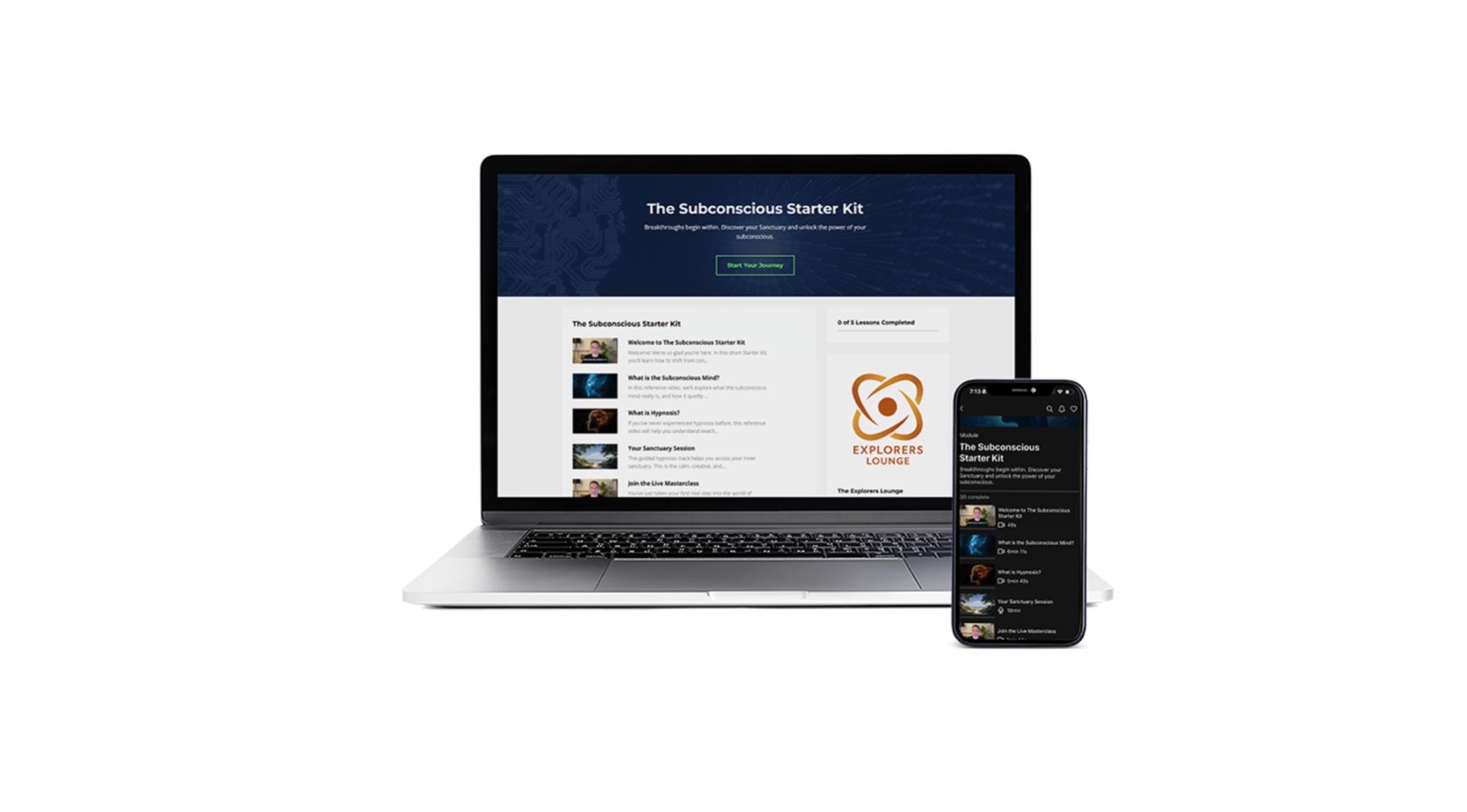
That’s one of the reasons we created the Subconscious Starter Kit inside the Subconscious Academy app. The Starter Kit introduces a few of the key principles behind how subconscious patterns shape action and follow-through, and it includes a guided hypnosis experience called the Sanctuary Session. The goal of that session is not to force new beliefs into the mind, but to help the nervous system settle and become more receptive to new interpretations and possibilities.
When people begin to recognize that the stories guiding their behavior are simply patterns the mind learned earlier in life, something interesting happens. The beliefs that once felt permanent start to look more like maps that can be revised.
If you’d like to explore that idea further, you can access the Subconscious Starter Kit below.
And if you prefer watching rather than reading, you can also view the full explanation in the video below or on YouTube.
👉 Watch the video on YouTube
👉 Access the Subconscious Starter Kit
Just because a belief feels true doesn’t mean it is.
Sometimes it simply means the mind has repeated that story long enough that it feels familiar.
And familiarity, when left unquestioned, can quietly shape a life.
Breakthroughs Begin Within.
Start with the Free Starter Kit to better understand the patterns behind your resistance, build steadier internal alignment, and access our free live training.