When Hard Work Isn’t Paying Off: How to Decide What to Do Next

By Ryan Nichols
There is a particular kind of uncertainty that appears after you have been working hard for a while and the result still has not arrived.
At the beginning, effort can feel encouraging. You are building, learning, testing, and moving. But after enough time passes, the same work can start to feel like evidence against you. You may wonder whether you are being persistent or simply refusing to see that something is not working.
That question rarely has an instant answer. It becomes even harder when the outcome matters deeply to you, because every setback can begin to feel personal.
A useful review does not ask you to choose between blind optimism and giving up. It helps you separate the result you hoped for from the information your effort has actually produced.
For the accompanying discussion, watch When Your Hard Work Isn’t Paying Off.
When “work harder” stops being useful advice
Effort matters, but effort by itself cannot tell you whether your approach is effective.
You can work very hard on the wrong message, offer, habit, or strategy. You can also be using a sound approach that needs more time, more repetition, or a smaller adjustment than you realize.
This is why a difficult result should lead to a review, not an automatic verdict.
“It has not worked yet” is an observation. “I am failing” is an interpretation. Those two statements can feel identical when you are discouraged, but they lead to very different decisions.
The following five questions can help you create some distance before deciding what to do next.
1. What did I expect to happen by now?
Write down the result you believed you would have at this point. Be specific about the number, date, or visible change you were expecting.
Then ask where that expectation came from.
Was it based on previous experience? A realistic benchmark? Something another person achieved? Or did it gradually become a deadline in your mind without ever being examined?
An expectation can be useful even when it turns out to be wrong. It gives you something concrete to compare with reality. The problem comes when the expectation quietly becomes a measure of your value.
If you expected ten clients and found two, the gap deserves attention. But “two” is not the same as “nothing.” It may show that people will buy, while also showing that your route to reaching them needs work.
Begin by naming the expectation without defending or condemning it. You are gathering information.
2. What evidence exists beyond the headline result?
The headline result is usually the easiest thing to see: the sale, promotion, weight change, completed project, or other outcome you wanted.
But progress often produces earlier signals.
Perhaps more people are responding, even if they have not purchased. Perhaps your work is taking less time. Perhaps you can explain your offer more clearly than you could a month ago. Perhaps you followed through consistently for the first time, or discovered a problem before investing more heavily in it.
These signals do not need to be turned into consolation prizes. A lack of sales is still a lack of sales. A missed goal is still a missed goal.
The point is to see the whole picture. If you look only at the final result, you may discard useful evidence. If you look only at encouraging signs, you may avoid a necessary change.
Try listing three kinds of evidence:
- Outcome evidence: What measurable result did you get?
- Process evidence: What became clearer, faster, or more consistent?
- Response evidence: How did other people or the environment respond?
Looking at all three can help you decide whether the gap is in the goal, the strategy, the execution, or simply the timeline.
Progress can also be difficult to recognize when each new milestone quickly starts to feel normal. In Why Getting Closer Doesn’t Feel Like Winning, I explore why meaningful change does not always feel as dramatic as we expect.
3. Which part of the process is not working?
“This is not working” is often too broad to guide a decision.
Instead, break the process into stages. If you are trying to sell something, for example, the stages might include reaching people, earning attention, creating interest, making an offer, and completing the sale.
Where does movement stop?
If nobody sees the offer, rewriting the checkout page may not help. If people show interest but do not buy, increasing your posting schedule may only create more of the same traffic. If people buy but do not get the promised result, the problem is somewhere else again.
The same principle applies outside business. If you are trying to build a habit, is the difficulty starting, remembering, continuing when the day changes, or returning after you miss once?
A specific problem gives you something to test. A global judgment about yourself does not.
4. What has this effort taught me that should change the next attempt?
Hard work becomes more valuable when it improves the next decision.
Ask yourself what you know now that you did not know when you began. You may have learned something about your audience, your preferences, your capacity, the environment, or the assumptions built into your plan.
Then translate that lesson into a change you can observe.
“I need better marketing” is difficult to test. “For the next two weeks, I will use one clear problem in every headline and track which message earns a response” gives you a next step.
“I need more discipline” is similarly broad. “I will make the first version small enough to finish in twenty minutes” creates a condition you can actually try.
A lesson is not complete because it sounds insightful. It becomes useful when it changes the design of the next attempt.
5. What decision would I make if I did not need certainty?
Many decisions feel impossible because we believe we should know in advance which choice will prove correct.
You may not be able to know that.
What you can often do is choose the next reasonable experiment. You can continue for a defined period, change one important variable, reduce the commitment, ask for outside feedback, or stop investing in one direction while preserving what you learned.
A decision does not have to settle the rest of your life. It can define what you will test next and when you will review it again.
Try completing this sentence:
“Based on what I know now, I will ______ for the next ______, and then I will review ______.”
This gives persistence a boundary and change a purpose. You are not waiting indefinitely, and you are not demanding certainty before you move.
A simple progress review
Set aside fifteen minutes and create four columns:
- What I wanted to happen
- What actually happened
- What I learned
- What I will test next
Keep the first two columns factual. This makes it easier to notice when a subconscious rule enters the review.
Rules such as “If it has not worked yet, I have failed,” “If I change direction, the effort was wasted,” or “If I were capable, I would already know what to do” can turn feedback into a threat.
When that happens, you are no longer only evaluating the strategy. You are defending your identity.
Noticing the rule does not mean you need to argue with it immediately. Simply name it, then return to the evidence in front of you.
If every review becomes another reason to criticize yourself, the pattern explored in Why You’re So Hard on Yourself may help you separate honest accountability from self-attack.
You may decide to keep going. You may decide to change course. You may decide that the goal still matters but the current method does not.
None of those choices has to be a verdict on who you are.
Your effort has already produced information. The next question is how you will use it.
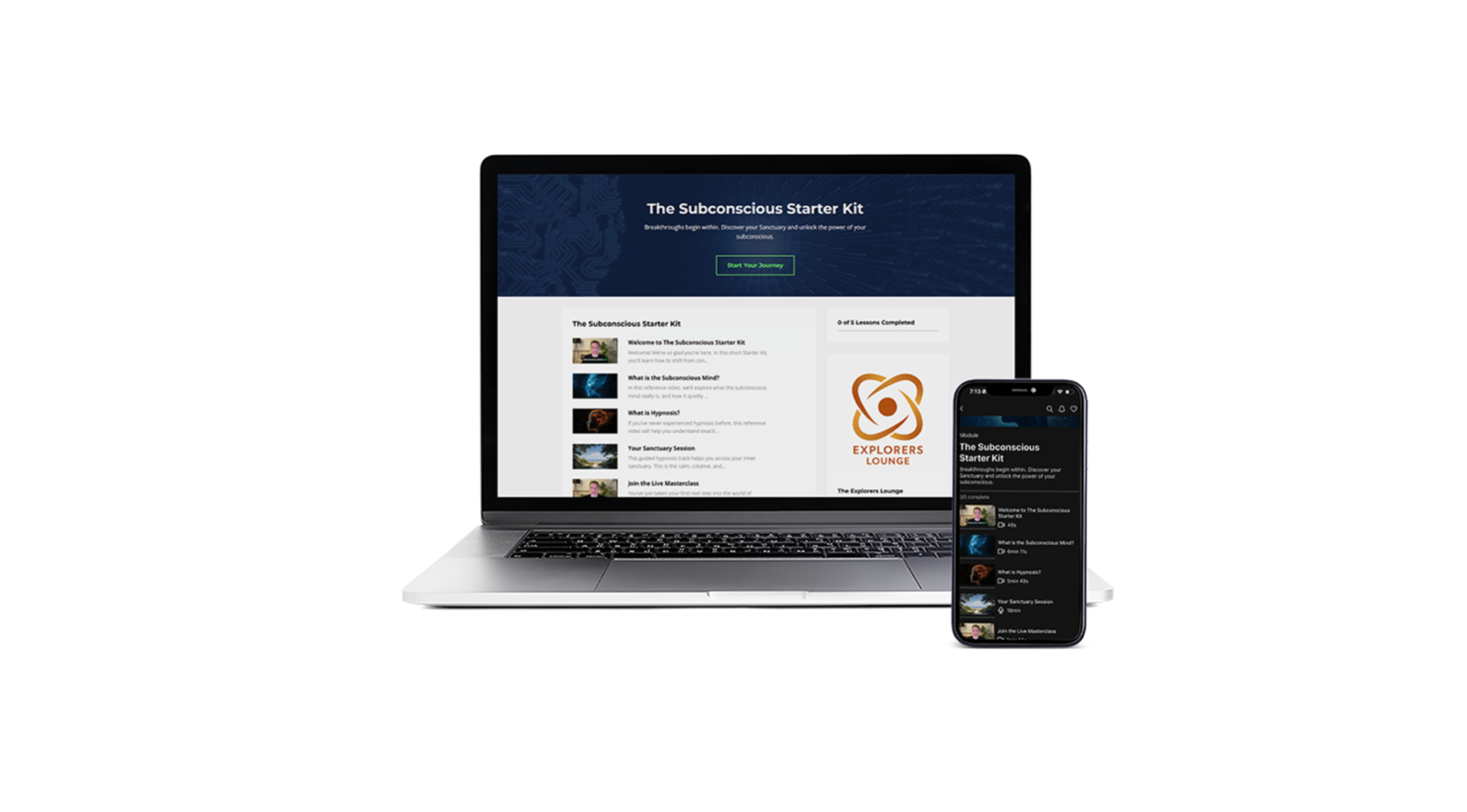
If you would like to explore how learned beliefs and automatic patterns influence the way you respond to uncertainty and setbacks, the free Subconscious Starter Kit is a place to begin. It includes foundation videos and the Sanctuary Session guided audio.
Breakthroughs begin within.
Start with the Free Starter Kit to better understand the patterns behind your resistance, build steadier internal alignment, and access our free live training.